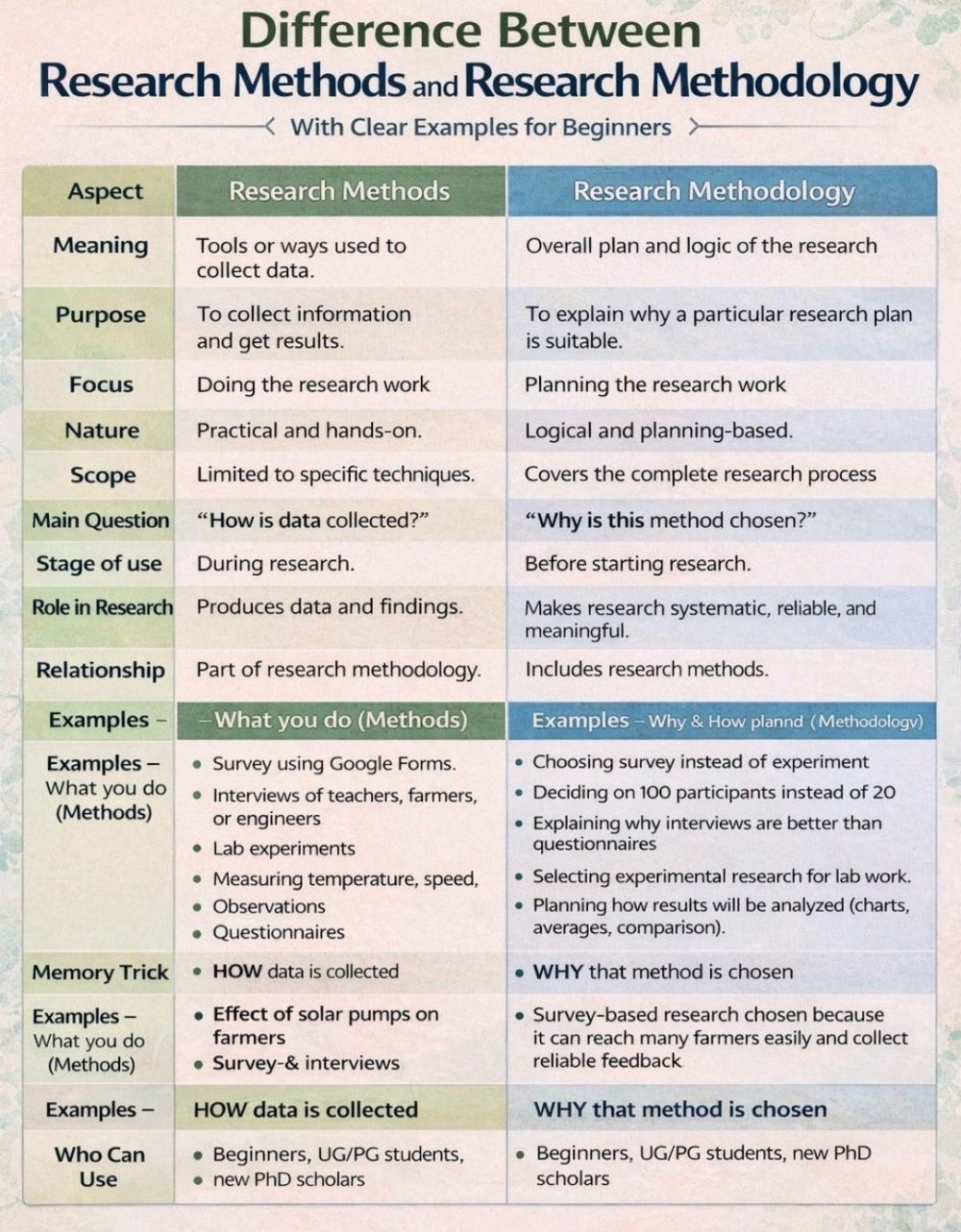
If you’ve ever found yourself using "method" and "methodology" interchangeably in your draft, you aren't alone. In casual conversation, the difference might seem pedantic. But for a graduate student or an early-career researcher, mixing these up is more than a typo—it’s a signal of your "researcher maturity."
Let’s verbalize the distinction using the framework of the infographic to help you frame your next chapter with precision.
In the infographic, Methods are presented as the practical, technical side of research. Think of methods as the tools in your belt.
Methodology is the intellectual "skin" that covers your methods. As shown in the infographic, it is the overarching strategy and the logic behind your choices.
Based on the infographic’s breakdown, here is how they differ in the context of your academic writing:
| Feature | Method | Methodology |
| Question it Answers | How did you do it? | Why did you do it that way? |
| Scope | Narrow: Specific techniques. | Broad: The entire research strategy. |
| Placement | Usually found in the "Methods" section of a paper. | Found in the "Methodology" chapter of a thesis. |
| Timing | Applied during the data collection and analysis phase. | Developed during the research design and proposal phase. |
| Analogy | The hammer and nails. | The architectural blueprint. |
When you sit down to write your Methodology Chapter, your committee isn't just looking for a list of what you did (that's just the Methods). They are looking for the Methodological Rigor:
To put it simply: Methods are the steps you took to find the answer. Methodology is the reason those steps make sense in the first place.
Next time you open your manuscript, ask yourself: Am I describing the tool, or am I justifying the craft? Understanding this distinction won't just improve your writing—it will make you a more confident researcher during your defense.
For more information visit the Science and Research Institute at the University.
Follow us on social media: https://www.linkedin.com/posts/science-and-research-uev_augauqaugaukaulausauoavdautauuauvauoauxaugautaul-activity-7416816535861620737-ooqa
13 Jan 2026